
The workspace before, during and after the event.
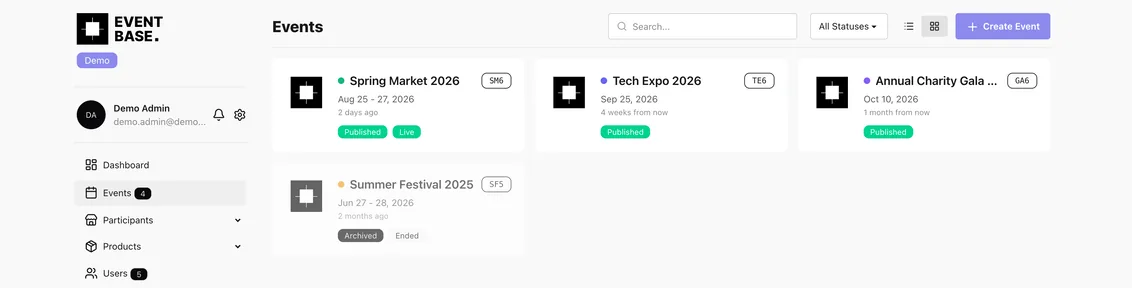
Event Base holds the records every part of Event Stacks depends on: events, exhibitors, products, tickets, staff, booths, gates and reports. The field apps, the portal, ticket pages and AI all work from that same source.
Event Base admin — the events list
Plan once, reuse every year
Your product catalogue, your exhibitors and your producers live at team level and are reused across every event. Ticket types, floorplans, staff shifts and tasks live inside a single event. Next year's edition starts from everything you already built.
Team level
Products, categories, producers, participants, participant types, users and settings.
Created once, used everywhere.
Event level
Ticket types, registration forms, floorplan, staff and shifts, tasks, points of sale and currencies.
Specific to a single edition.
Seven jobs, one system
Start with the jobs your event actually has. A festival may use all seven; a summit may only need registration, sponsors, check-in and live reporting.
Ticketing & registration
Sell online from your own pages, seat the room, mail the tickets and wallet passes.
→
Access control
Gates, re-entry rules, encrypted QR scanning and live admissions.
→
Participants & portal
Exhibitors who submit their own products, documents and revenues.
→
Products, POS & sales
A reusable catalogue, per-booth pricing, stock, currencies and reporting.
→
Staff, tasks & time
Shifts, job lists and timecards, from planning through payroll.
→
Live operations
The event-day dashboard, connected devices, surveys and the activity log.
→
AI assistant & MCP
Answers and actions on your own data, fully audited and unable to delete.
→
Three roles, enforced on every action
Admin, Editor and Viewer. Permissions are checked on the action itself, not hidden in a menu, and everything anyone changes lands in the activity log with who did it and through which channel.
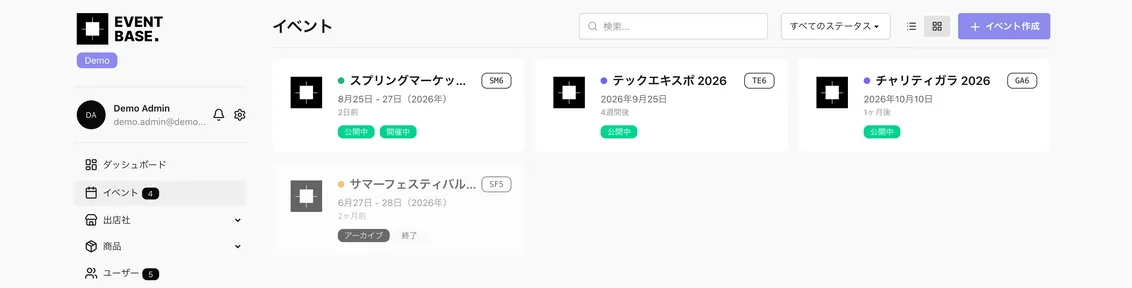
Japanese and English, any currency, any timezone
The whole product ships in both languages, and each user reads it in their own. Every event carries its own timezone and its own currencies, so an organiser running Tokyo, Brussels and Singapore does not run three systems.
The same event in English and Japanese, side by side
And six apps on site
Event Base is the hub. The Stacks are what your team carries at the venue — selling, scanning, recording, checking tasks and clocking in, all against the same data.



Questions organisers ask
- Do we have to use every feature?
- No. Features are enabled per event. A conference with no booths never sees points of sale, and a market with no seating never sees the floorplan.
- Can we run several events at once?
- Yes. Events are independent, with their own team, currencies, timezone and settings, while sharing your catalogue and your exhibitors.
- What happens to our data between events?
- It stays. Products, exhibitors and producers are team-level records, so next year's edition starts from what you already built rather than from an empty workspace.
- Can we get our data out?
- Yes. Exports throughout the admin, plus a GraphQL API and an MCP endpoint for anything programmatic.
- Is our data separate from other organisations?
- Yes. Each organisation has its own database, identified by its own domain — not a shared table with a tenant column.
See Event Base with your own event in it
Thirty minutes, in English or Japanese. We set it up before the call.